

Teams are connected — but capability does not scale at the same pace.
Communication has improved, but knowledge remains fragmented. Learning exists, but its translation into real capability and performance is inconsistent. This reflects a deeper issue. The challenge is no longer access to tools. It is how organizations structure, connect, and operationalize knowledge and learning within everyday work.
The Shift: From Interaction to Capability
Workplace interaction — idea exchange, collaboration, and shared problem-solving — plays a critical role in how people develop skills. Research consistently shows that:
- Teams that learn together perform better.
- Social and collaborative learning significantly increase engagement.
- Practical, work-based experience accounts for a large share of capability development.
But interaction alone is not enough. Without structure, continuity, and integration into workflows, interaction remains: episodic, informal and difficult to scale. The result is a gap between:
- What people know
- What organizations can reliably execute
To close this gap, interaction must evolve into structured knowledge flow and capability development.
The Real Problem: Fragmentation
Most organizations today operate with:
- Communication tools (chat, email, collaboration platforms)
- Learning systems (LMS, LXP, training programs)
- Knowledge repositories (documents, portals, shared drives)
- Core enterprise systems (ERP, HR, SIS, project and workflow management platforms)
Each of these serves a purpose, but they are rarely connected into a coherent operating model.
This leads to predictable outcomes:
- Knowledge is created but not reused effectively
- Learning is delivered but not embedded into workflows
- Expertise exists but is difficult to access
- Skills develop unevenly across teams
In other words: Communication happens. Capability does not scale.
Why Platforms Must Become Knowledge Hubs
To address this, organizations need to move beyond isolated tools toward digital knowledge communities — structured environments where communication, knowledge, and learning converge. A knowledge hub is not just a portal or collaboration tool. It is an operational layer that:
- Connects people to relevant knowledge and expertise
- Embeds learning into real workflows
- Enables continuous feedback and improvement
- Translates interaction into measurable capability
Core Components of a Knowledge Hub
A well-designed digital knowledge environment typically includes:
- Centralized Knowledge Management: A structured repository of organizational knowledge, policies, practices, and expertise — accessible and continuously updated.
- Integrated Communication Channels: Discussion spaces, forums, and collaboration tools linked to real work contexts — not disconnected conversations.
- Collaborative Workspaces: Environments where teams co-create, solve problems, and execute tasks together — turning knowledge into action.
- Embedded Learning Experiences: Contextual, role-based learning integrated into daily work rather than separate training events.
- AI-Enabled Knowledge Access: Intelligent systems that connect users to relevant content, surface expertise, and support decision-making.
- Continuous Feedback and Recognition: Mechanisms that reinforce contribution, learning, and improvement across teams.
The Role of AI: From Access to Execution
As organizations explore AI, the key question is not whether to adopt it — but how. AI delivers real value when it is:
- Integrated into platforms
- Supported by structured data
- Governed within operational processes
In this context, AI becomes an execution layer:
- Automating workflows
- Enabling knowledge retrieval
- Supporting real-time decisions
- Enhancing responsiveness across services
Without integration and governance, AI remains disconnected and limited in impact.
From Knowledge to Skills: Closing the Capability Gap
One of the most critical outcomes of a knowledge-driven environment is its impact on skills. Workplace experience contributes significantly to human capability. Yet in many organizations:
- Skills are developed informally
- Recognition is inconsistent
- Progression is unclear
By structuring knowledge and interaction, organizations can:
- Accelerate practical skill development
- Improve consistency across teams
- Enhance innovation and problem-solving
- Support continuous, experience-based learning
This begins to close the gap between learning effort and real capability.
Why This Matters Now
Organizations are under increasing pressure to improve productivity, build future-ready skills and respond faster to change. At the same time: knowledge is expanding, work is becoming more complex and skills requirements are evolving rapidly. This makes it essential to move beyond isolated platforms, fragmented learning, and unstructured knowledge toward integrated, operational environments that support capability at scale.
consultxME Point of View
At consultxME, we see this challenge consistently across institutions and enterprises. Organizations invest in:
- Communication tools
- Learning systems
- Digital platforms
But without integration, these remain separate layers. Our approach focuses on connecting:
- Experience platforms (CRM and engagement layers)
- Enterprise systems and data flows
- Knowledge and capability development models
Our objective is to create environments where knowledge is accessible, learning is embedded, and capability becomes operational.
In this model, communication is not the objective — capability is.
Conclusion
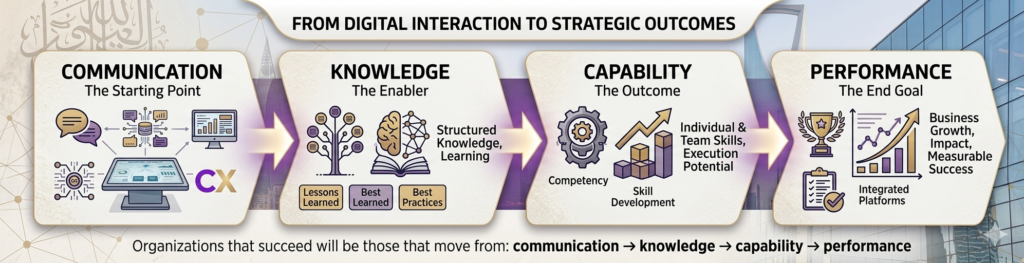
The future of work is not defined by tools, but by how effectively organizations connect knowledge, learning, and execution. In this future:
- Digital interaction is a starting point.
- Structured knowledge is the enabler.
- Integrated platforms are the foundation.
- Capability is the outcome.
Organizations that succeed will be those that move from:
communication → knowledge → capability → performance
Such organizations build environments where learning is continuous, visible, and directly linked to outcomes.