

The skills debate is no longer enough. As AI accelerates changes in work, the bigger challenge is whether our education and workforce institutions can turn changing market signals into timely, coordinated action.
Artificial intelligence is changing the labour market, but perhaps its more important effect is revealing how difficult it is for our existing education and workforce institutions to adapt at the same speed.
In July 2026, the Stanford Digital Economy Lab published a statement signed by more than 200 economists and AI researchers, including Nobel Laureates, calling for urgent preparation for AI's economic impact. The statement argued that increasingly capable AI could reshape the economy at unprecedented speed and specifically called for the policies and institutions needed to ensure that AI complements human capabilities rather than leaving society to react after the transformation has already begun
The speed of economic change is beginning to exceed the speed of institutional response.
The pressure is already visible in workforce planning. The World Economic Forum's Future of Jobs Report 2025, based on input from more than 1,000 employers representing over 14 million workers across 55 economies, estimates that 59 out of every 100 workers will require training by 2030. The report also identifies skills gaps as the most significant barrier to business transformation, cited by 63% of employers.
The World needs adaption at an enormous scale…
Yet increasing the volume of training does not automatically resolve the problem. Cengage Group's 2025 US employability study found that 48% of recent graduates felt unprepared even to apply for entry-level roles, while 56% of those who felt unprepared identified job-specific skills as their biggest gap. The same study found a notable difference between what educators believed they were preparing students for and what employers prioritised.
Taken together, these signals point to a challenge that is broader than skills supply. We have become increasingly sophisticated at identifying emerging skills, forecasting occupational demand, creating new credentials, expanding professional education and introducing reskilling initiatives. What remains harder is ensuring that all of these activities operate as parts of a responsive human-capital system. That distinction matters.
Human capital is more than developing skills
Most discussions about workforce readiness begin with development: what should people learn, who should teach it, and how quickly can they acquire new capabilities? Development is clearly fundamental. It includes formal education, professional training, reskilling, practice and experiential learning. But capability creates limited economic value simply by existing. It must also become visible.
Employers need credible ways of understanding what a person knows, what they have experienced and what they can actually do. Traditionally, the degree carried much of this signalling responsibility. It remains important, but it now operates alongside professional certifications, digital credentials, portfolios, project work, skills profiles and verified experience.
A third step is equally important: capability must reach an opportunity where it can be used. Hiring, internships, career pathways, mobility, matching and workforce redeployment are therefore not activities sitting downstream from human-capital development; they are part of the same value-creation process.
Seen in this way, a functioning human-capital system has three interdependent responsibilities: develop capability, signal capability and deploy capability.
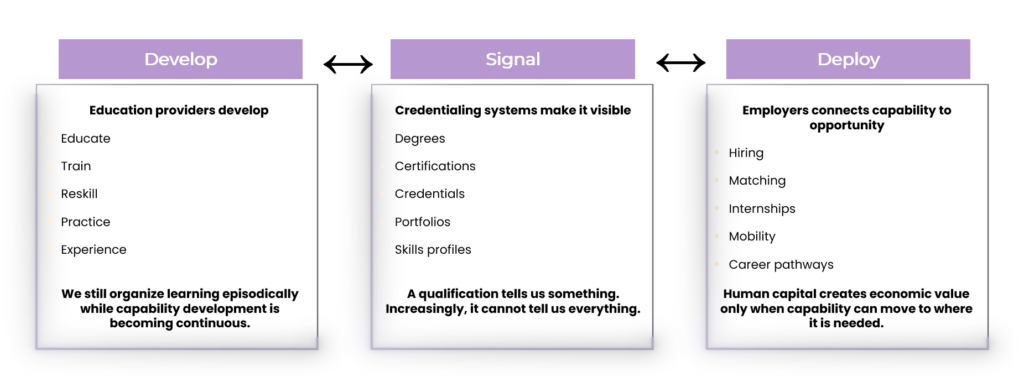
We invest substantially in each of them. The difficulty is making them work cohesively.
Education providers can improve learning while employers still struggle to understand what graduates can do. Credentialing systems can become more sophisticated while learners struggle to connect those credentials to opportunities. Employers can deploy advanced recruitment and matching technologies while the supply side remains slow to adapt to changing requirements.
The challenge, therefore, is not simply strengthening individual components. It is improving how institutions receive information, interpret it and act on it.
This is becoming particularly important because AI changes not only which capabilities are required, but also the speed at which those requirements evolve. Maria Flynn, CEO of Jobs for the Future, has argued that education and workforce systems designed for an earlier era are struggling to keep pace with AI-driven changes in labour-market supply and demand.
Higher education offers a useful lens through which to examine this problem.
“Our education and workforce systems were really built for a different era”
Maria Flynn, CEO, Jobs for the Future
Turning labour-market signals into institutional action
It would be inaccurate to suggest that universities are disconnected from the labour market or unaware of the employability challenge.
Many institutions now use employer advisory boards, graduate outcomes, labour-market data, internships, cooperative education, professional certifications, microcredentials and industry partnerships to improve relevance. Governments have also invested heavily in occupational classifications, skills frameworks and labour-market intelligence.
The sensors are increasingly in place. The harder problem is what happens after a signal enters the institution.
A changing employer requirement may be visible in labour-market data within months. Translating that change into a university response may require curriculum redesign, faculty decisions, governance approvals, accreditation considerations, new experiential opportunities and changes in student guidance. These processes exist for legitimate reasons, but they operate through different functions and at different speeds. The labour market may describe the change in terms of roles, tasks and skills. Academic institutions operate in the language of programs, courses, credits and learning outcomes. Somebody must translate between the two. Responsibility is also distributed.
Academic Affairs may own programs and curricula. Faculty members own teaching and much of the advising relationship. Accreditation functions oversee standards and outcomes. Career Services supports career readiness and opportunity. Industry Engagement manages employer relationships, projects and internships. Institutional Research may track graduate performance.
Each function can be performing its role competently while the student still experiences a fragmented journey. This is the difference between having the sensors and having the nervous system. The signals exist. Data exists. Feedback exists. The missing capability is often the ability to turn those signals into coordinated, timely action around the learner.
One learner journey, multiple institutional silos
From the student's perspective, there is no organisational chart. There is simply a journey.
A student enters university, begins making choices about disciplines and courses, develops knowledge, gains experience, forms an understanding of possible careers and eventually moves into employment. The consequences of many of those choices compound over time. A decision made in the first or second year may influence which experiences become available later, which capabilities are developed, which employers become relevant and which pathways remain open.
Yet employability is still too often concentrated toward the final stages of this journey.
Career fairs, CV preparation, interview support and vacancy matching are valuable services, but if serious engagement with the labour market begins close to graduation, the student has relatively little room left to adapt academic choices, build missing capabilities or gain meaningful experience.
One way to illustrate this is to borrow the familiar shape of a hype cycle — not as empirical data, but as a metaphor for the transition many students experience.
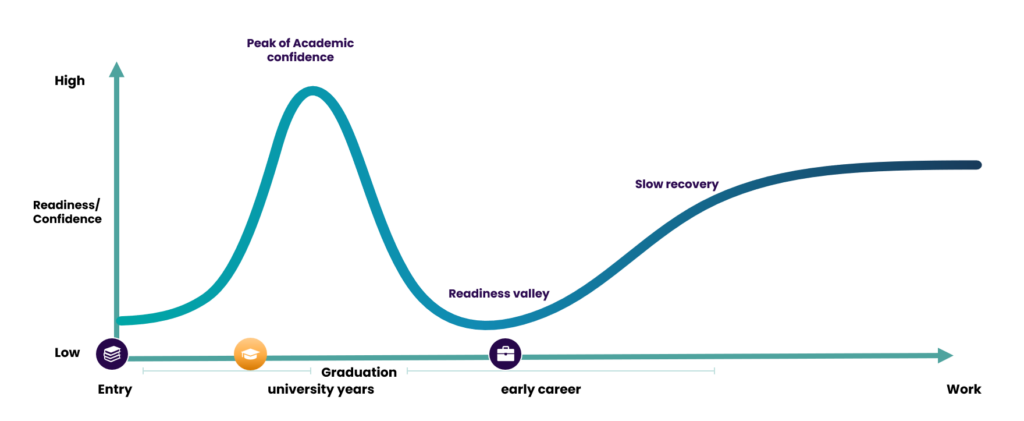
During university, academic knowledge and confidence can build steadily. The student progresses through courses, assessments and milestones within an environment whose expectations are relatively well defined. Graduation then introduces a different test: the learner must translate academic achievement into workplace capability, understand employer expectations, navigate opportunities and demonstrate what they can actually do.
This can create what we might call a readiness valley.
The student has not suddenly lost knowledge. Rather, academic confidence meets the practical reality of the labour market, and the gap between the two becomes visible.
For many graduates, confidence and effectiveness rise again over time as they accumulate workplace experience. But if that recovery happens mainly after graduation, the system is effectively asking employers and graduates themselves to complete part of the transition that could have begun much earlier.
The objective should therefore not be to eliminate the transition from education to work. That transition is real and will always involve adjustment.
The objective should be to raise the readiness valley and smooth the transition.
That means bringing elements of employability forward into the student journey.
Students should have career intelligence early enough to understand possible destinations and the implications of their choices. Faculty should have access to relevant information that helps them advise students in relation to both academic and capability pathways. Applied projects, internships and other experiential learning should allow students to test learning in real contexts before graduation.
Employers should be able to engage earlier through projects, mentoring, internships and talent communities. Students should progressively build visible evidence of capability through their learning, credentials, projects and experiences. And universities should capture what happens after graduation and feed that intelligence back into curriculum planning, student guidance and industry engagement.
The goal is simple:
Graduation should not be the point at which students first discover the labour market.
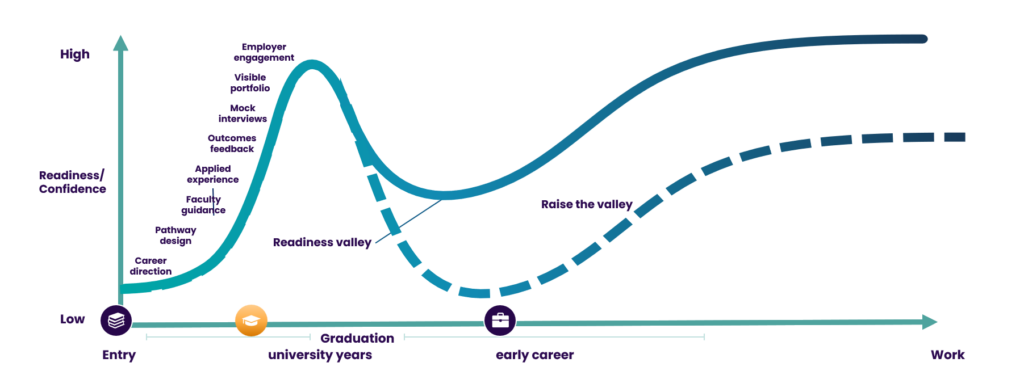
That transition will never disappear entirely, nor should universities attempt to turn every degree into narrow vocational training. Higher education has purposes that extend well beyond preparation for a first job.
But the transition can be made considerably more deliberate.
The objective should be to bring the labour market into the student journey earlier, without compromising the broader academic mission.
Students should have enough career intelligence early in their studies to understand possible destinations and the implications of their choices. They should be able to change direction while there is still time to do so.
Faculty should have access to relevant information that helps them advise students not only academically, but also in relation to possible capability and career pathways.
Applied projects, internships and other forms of experiential learning should provide opportunities to test learning in real contexts before graduation.
Employers should be able to interact with students earlier through projects, mentoring, internships and talent communities rather than appearing only when recruitment begins.
Students should progressively build visible evidence of capability through their learning, credentials, projects and experiences.
And universities should capture what happens after graduation and feed that intelligence back into curriculum planning, student guidance and industry engagement.
The point is not to add another department or another isolated employability initiative. It is to connect what often already exists.
Learning to Earning as an institutional journey
This leads to a different way of thinking about employability.
Instead of treating career readiness as a service applied toward the end of the degree, universities can treat Learning to Earning as a continuous institutional journey beginning much earlier in the student's experience.
Doing so requires more than coordination meetings between departments. The underlying information, workflows and decisions also need to connect.
A student's academic record should be capable of interacting with career interests, skills information, experiential learning, employer engagement and evidence of capability. Faculty and advisers need appropriate visibility. Employers need meaningful ways to engage. Career functions need to operate throughout the journey rather than mainly at its end. Outcomes need to flow back into planning.
The institutional objective must come first: create a coherent journey around the learner, establish who needs to act at each stage, determine what information they require, and ensure that feedback produces action rather than merely another report.
The shift from skills to systems
The skills conversation remains essential. AI will continue to change which capabilities matter, how they combine and how frequently people need to renew them. But identifying skills is increasingly only the beginning of the challenge.
The more consequential question is whether the surrounding system can continuously convert labour-market change into institutional action; institutional action into relevant learning and experience; learning into visible capability; capability into opportunity; and employment outcomes back into better decisions.
That is a fundamentally different task from simply offering more courses or producing more credentials. It requires institutions that can sense, interpret, coordinate, act and learn.
For universities, this means looking beyond the traditional boundary between education and employment. A learner's progression into work should not be treated as a separate journey beginning at graduation. It is the continuation of decisions, learning and experiences accumulated from much earlier in the university lifecycle.
The opportunity is therefore not to replace education with employability, nor to subordinate universities to short-term labour-market demand. It is to connect academic purpose more effectively with the realities students eventually have to navigate.
In an era when work is changing faster than institutions were designed to respond, that connection becomes increasingly important.
Learning to Earning should be one connected journey.
_________________________________________________________________________________________________________
This article builds on the ideas presented by Mohammed Husamaddin in his LEAP 2026 keynote, From Skills to Systems: Rebuilding Human Capital in the Age of AI.
References
Stanford Digital Economy Lab, We Must Act Now: Sixteen Nobel Laureates Join Leading Economists and AI Researchers in Call to Prepare for AI's Economic Transformation, July 2026. Stanford Digital Economy Lab
World Economic Forum, The Future of Jobs Report 2025. Future of Jobs Report 2025
Cengage Group, 2025 Graduate Employability Report, September 2025. Cengage 2025 Employability Report
World Economic Forum, Will AI Finally Fix the Skills Mismatch?, featuring Maria Flynn, CEO of Jobs for the Future. World Economic Forum – Skills Mismatch